
27 August 2026
Mistral AI and Home Assistant: Developing a home assistant
"Turn on the living room light." Behind this simple sentence lies a complex process: the assistant must understand the request, identify the relevant equipment and execute the correct action. Using Mistral AI Conversation, I have developed a Python integration that connects Mistral AI models to Home Assistant, the home automation platform I use for my personal infrastructure.
This project combines two subjects that interest me: home automation and the integration of artificial intelligence services. It allows users to interact with a model from Assist, Home Assistant's assistant, and give it access to home automation tools selected in the configuration.
From natural language to a concrete action
Let's take a use case example: asking Assist to turn on a lamp. Home Assistant then passes the conversation to my integration, which prepares the messages and the description of the tools available for Mistral. The model can then reply directly or request the execution of a tool with parameters, such as the name of the equipment to control.
This mechanism is called "tool calling". The model formulates a structured request and Home Assistant remains responsible for validation and execution. The result is then sent back to Mistral so that it can build its response to the user. The choice of APIs and exposed entities is therefore made within Home Assistant.
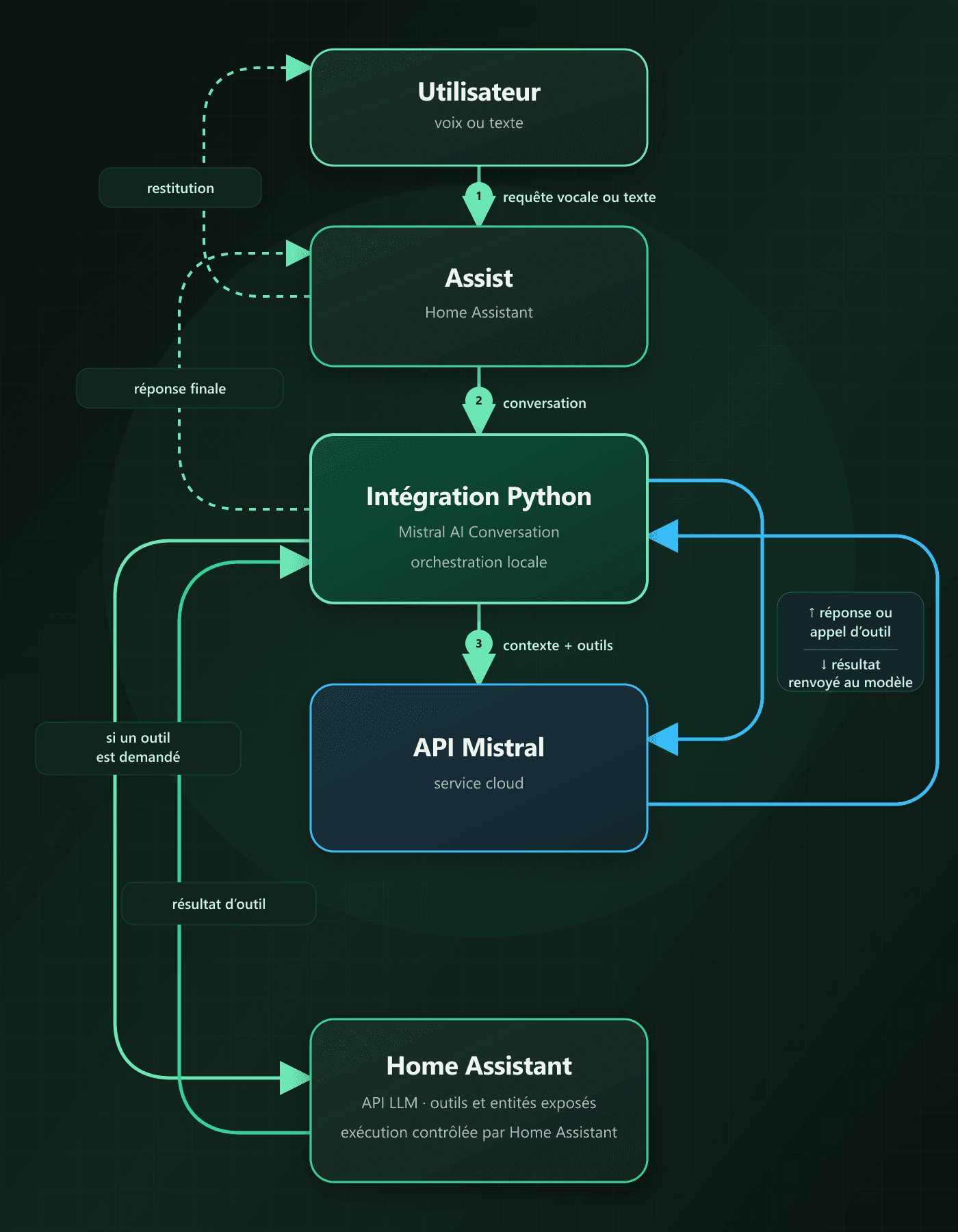
This separation of responsibilities is at the heart of the project: Mistral interprets the language, the integration adapts the exchanges between the two systems and Home Assistant manages the equipment. It is also possible to disable the exposed APIs to use conversation only.
An integration designed for Home Assistant
I used the official Mistral Python SDK and Home Assistant's native mechanisms. Network calls are asynchronous: while the remote service prepares its response, Home Assistant can continue processing its other tasks. Text arrives progressively, as a stream, which allows it to start displaying before generation is complete.
Configuration is handled via the interface: API key, model, instructions and accessible tools. Multiple agents can have their own settings on the same account. Model discovery and their capabilities also make it possible to check the compatibility of requested options, such as images or reasoning.
Handling a response that arrives in chunks
Receiving text progressively is one thing; reconstructing a reliable action request is another. A tool call can arrive in multiple fragments, with incomplete JSON parameters. Multiple calls can also be interlaced in the same stream.
I therefore separated this logic into a dedicated component. This component gathers the fragments of each call, reconstitutes the parameters and rejects malformed requests before execution. This step helps reconcile the flexibility of a language model with the structured data expected by home automation.
Exchanges are also limited: a maximum of 128 tools can be declared and a request cannot exceed 10 turns of tool calls. These limits prevent a request from triggering an endless loop. However, they do not guarantee that a model will always choose the right action.
Testing difficult cases, not just the demo
A useful integration must also react correctly in the event of an expired API key, network failure or invalid response. The project distinguishes between these different situations in order to offer re-authentication, report unavailibility or raise an understandable error.
Automated tests simulate Mistral's responses, including fragmented streams and tool calls. Specifically, one scenario verifies that a Home Assistant tool is called correctly, and then that its result is reinjected into the following request. These tests run without a real API key and without controlling a physical installation.
GitHub Actions groups Python style and typing checks, tests with an 85% branch coverage threshold, as well as HACS and Hassfest validations specific to the Home Assistant ecosystem. These checks help spot regressions and complement tests on a real installation.
Beyond conversation
The integration also offers AI tasks capable of producing structured data and accepts images or PDFs with compatible models. Voxtral voice features allow speech to be converted to text and an audio response to be generated within an Assist pipeline. Their availability depends on model capabilities and Mistral account access.
To facilitate installation and updates, the project is distributed via the HACS catalogue. It is an independent community integration, accompanied by documentation and a release history.
A cloud choice to be made explicit
Home Assistant and the integration run locally, but processing by Mistral uses a remote API. Messages, relevant history, exposed tools and their results are transmitted to the service, as are the files or audio used by the corresponding functions. Internet connection, sent data and API costs must therefore be taken into account.
I recommend limiting exposed equipment to actual needs, especially when an action involves physical access. The value of this project also lies in connecting an AI service to an existing system while handling configuration, errors, testing and maintenance. It is this continuity between software development and operations that interests me.