22 November 2026
Four months maintaining Mistral AI Conversation
The first article described how Mistral AI Conversation works, my integration linking Mistral AI models to Home Assistant. It said nothing about what has taken up most of my time since: releasing, fixing, replying. The first version came out on 26 July 2026. Four months later, the project has 31 releases, 74 commits and, according to GitHub statistics, between 500 and 1,000 active users. This second article tells the other half of the project: maintenance, responding to users, and how their reports guide development.
Maintaining the compatibility baseline
As long as an integration only runs on its author's setup, a regression can be fixed during the day without consequence. From a few hundred installations onwards, the same regression breaks someone else's living room at a time when I am not necessarily in front of the logs. The code itself does not change in nature; its consequences do.
Three rules translate this observation into practice. The Home Assistant compatibility baseline does not move: set to 2026.7.4 in late August, it is still valid today even though Home Assistant has moved from 2026.7 to 2026.11, and each reference version is tested. Any risky change goes through a pre-release, downloadable via the HACS beta channel. Finally, version upgrades use numbered migrations that preserve existing models, voices and settings: updating must never mean reconfiguring.
From issue reports to stable releases
Not all of these users speak up. The vast majority update via HACS and never write. Those who do write genuinely change the project, and that is the most interesting part.
Since July, the repository has received 11 issues; 10 are resolved, and the last one serves as a tracking thread for remaining audio features. Almost all developments in recent versions started from a suggestion or a report:
- Realtime Voxtral transcription (#54);
- text-to-speech volume normalisation (#62);
- image generation (#64);
- support for Voxtral 3 and the new SDK (#96);
- AI task evaluation (#104);
- transcription language selection and prompt caching (#106, #107).
Reported bugs illustrate the other side of this relationship. When Home Assistant 2026.9 replaced the schema converter expected by integrations, installations broke outright (#38): a pre-release was issued the next morning, and the stable version the day after that, while maintaining support for older versions. The blocking call that froze the event loop on startup (#51) was fixed and released the same day. The 400 error "Unexpected role 'tool'" that appeared when a local command preceded a Mistral turn in the same conversation (#77) was reproduced from the report, fixed and delivered straight away.
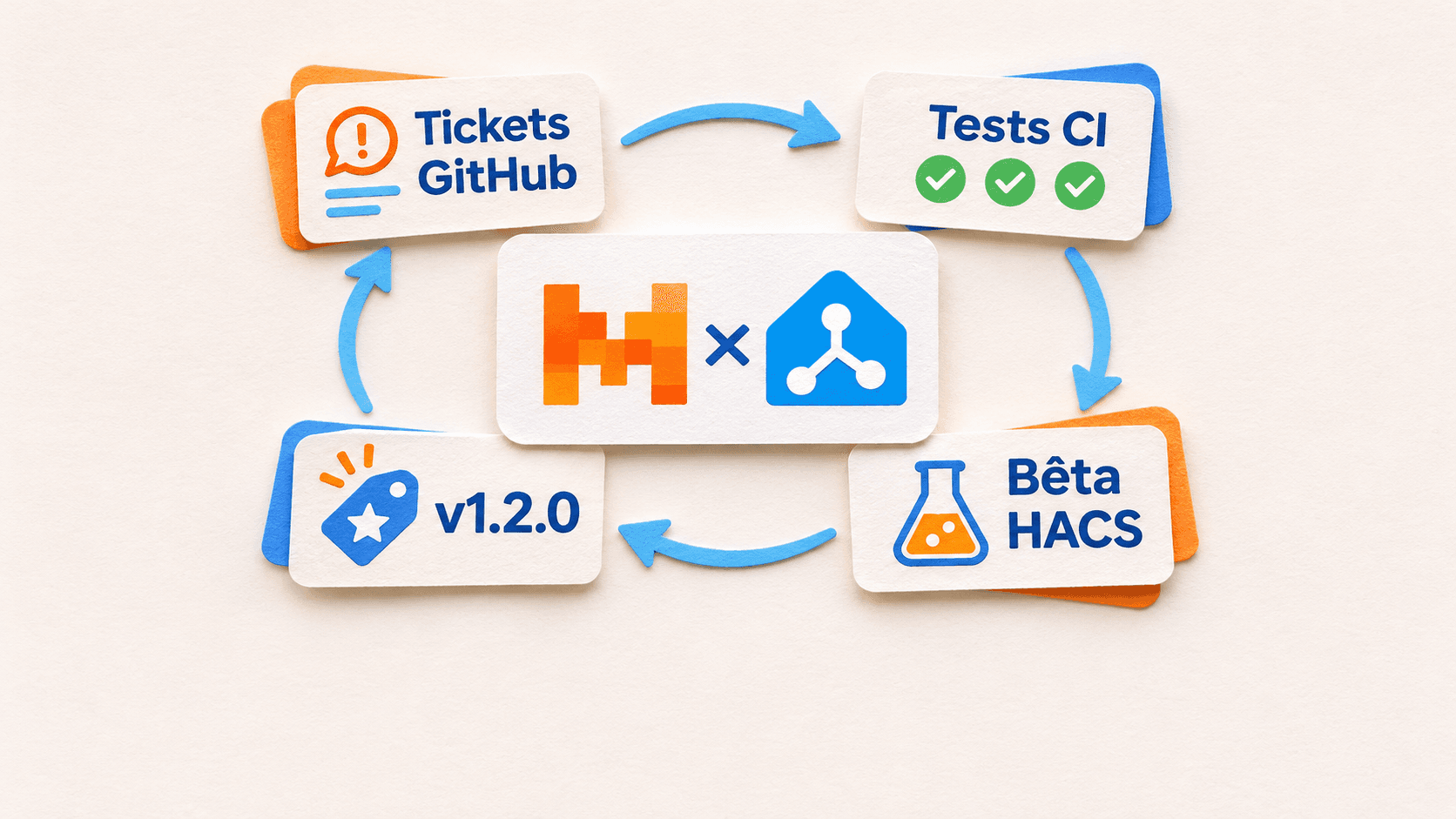
This cycle, repeated over four months, always looks like this:
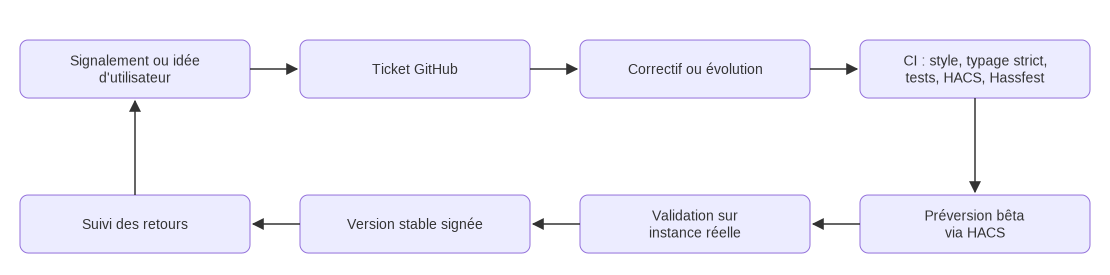
Pre-releases are not just used to deliver earlier: they are also used to frame feedback. The 1.2.0b1 notes specified exactly what to test, what information to report (model, Home Assistant version, transcription mode, redacted error) and above all what not to include: neither identifiers, nor real prompts, nor transcriptions. Beta testers' responses were incorporated into the stable version, published three days later, and both tickets were closed the following day.
Evolving dependencies
More than half of stable releases do not touch business code: they track dependencies. The official Mistral SDK went from 2.7.2 to 3.7.0 across eight bumps, each propagated to the runtime manifest, test environment and documentation; Ruff and mypy baselines follow, and test fixtures are resynchronised with each Home Assistant release via Dependabot.
The interesting point is not the frequency, it is the restraint. SDK 3 requires HTTPX2, the HTTP client that Home Assistant was not yet shipping in a stable version: two maintenance releases explicitly deferred it, because migrating would have excluded installations on older versions. Migration was only done when version 2026.11 made the shared client available, with a fallback for earlier versions: the project now tests five pinned combinations of Home Assistant and HTTPX2.
I also learned the hard way the importance of the compatibility floor: version 0.1.3 had raised it to 2026.8.1, and two weeks later 0.1.7 restored it to 2026.7.4. A user on a Raspberry Pi who updates twice a year is not an edge case, it is a normal case.
Four months of releases and testing
In four months, 31 releases went out, including 26 stable and 5 pre-releases, meaning roughly two per week:
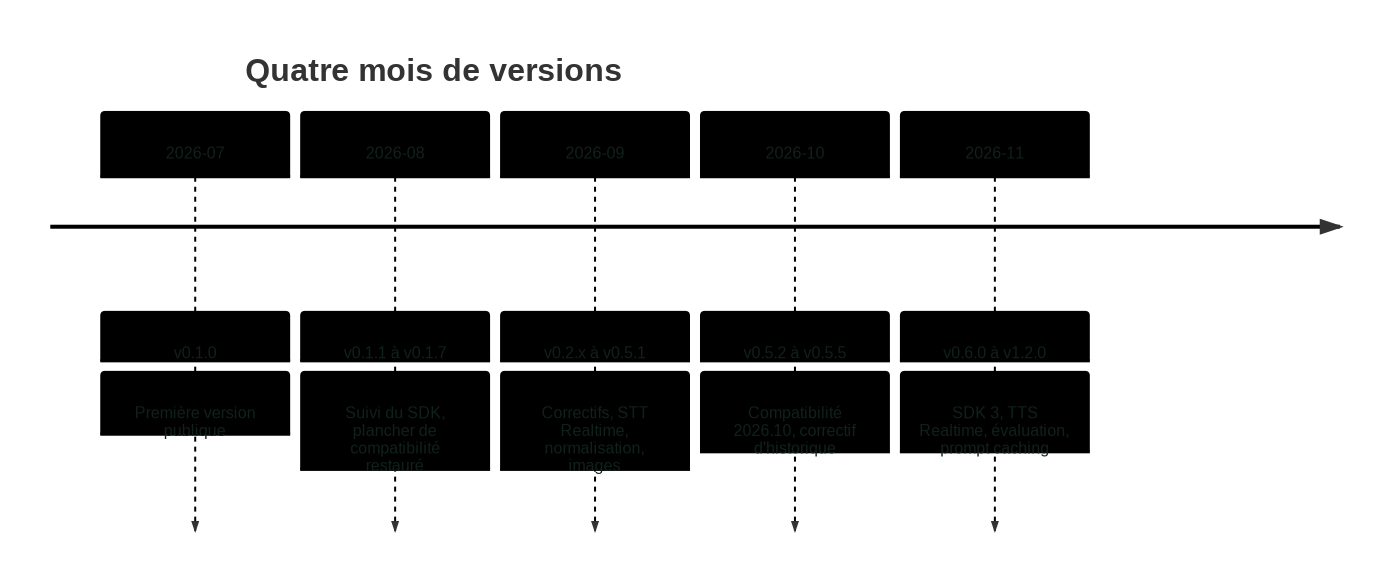
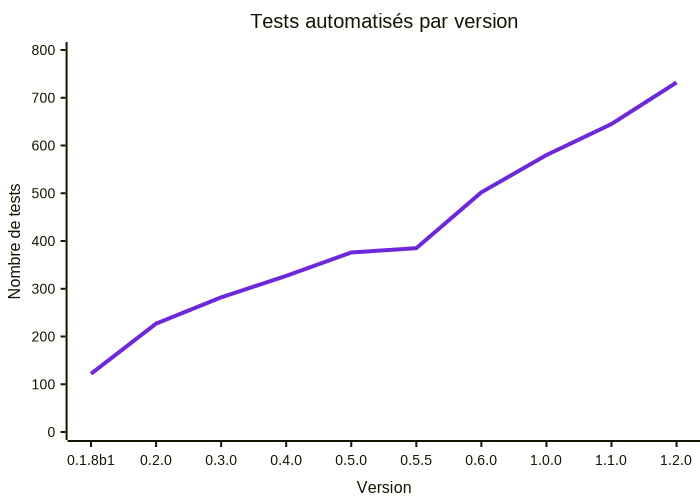
Each release follows the same schedule: automated checks, then verification on a real instance (fresh conversations, read-only tool calls, STT and TTS, structured AI tasks), then a signed release. The test suite has grown with the project:
November 6 alone sums up this period: version 1.0.0 with Realtime text-to-speech was released at 00:15; a patch fixing playback when a selected voice is identified by UUID and confirmed by Mistral by its official name followed at 09:50; and a packaging tweak allowing GitHub to count installations from the HACS catalogue and Marketplace closed the day at 23:59. Three publications in one day, each validated before being delivered.
All release notes also specify what has not been verified: physical voice satellites are not tested, live validation can be explicitly postponed when the test account reaches the provider's limits (this happened for the 1.2.0b1 audio checks, completed before the stable version), and a pre-release announces no conformance tested under real-world conditions. A tracking document documents these limits for each release.
This frankness adds a few lines to the release notes; it avoids the main thing: leading people to believe in a guarantee that does not exist. It is also what makes reports usable: a user who knows precisely what has been tested can more quickly identify what, on their end, falls outside the scope.
Maintenance is not post-development: it is another way of developing. You do not design the same configuration when you know a compatibility floor has to hold for four months, nor the same error handling when a poorly worded message generates a ticket rather than a resolution. Between the first article and this one, the project has gained users, test surface area and dependencies; above all, it has gained a feedback loop. Ten tickets resolved in four months is not ten problems extinguished, it is ten fixes written with the people who reported them. This continuity between software development and its operation is what I was looking for at the start; it has simply become collective.